The Whole Party, One Counter: How Teppanyaki Quietly Solved the Rehearsal Dinner
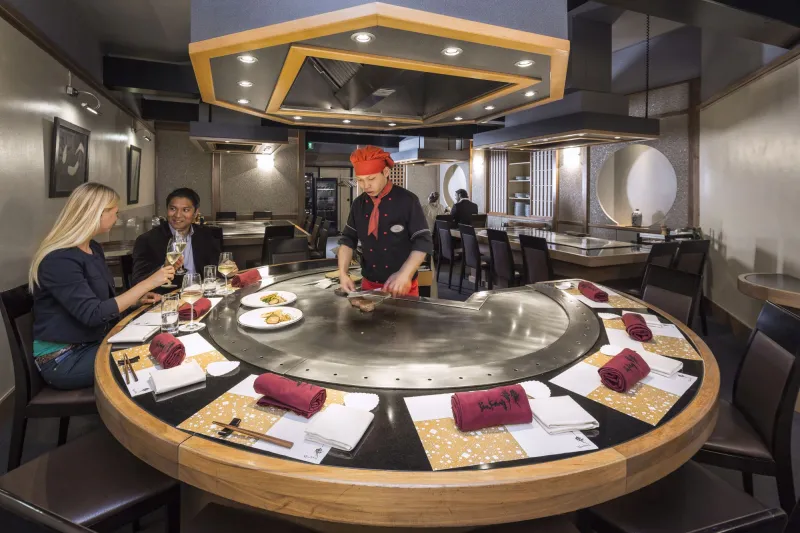
Photo: private teppanyaki counter restaurant event guests chef griddle, via i.pinimg.com
There is a moment, familiar to anyone who has planned a wedding, when the rehearsal dinner stops being a meal and becomes a logistics problem. Who sits beside whom. Which uncle cannot be seated near which cousin. Whether the restaurant's private room, with its dropped ceiling and laminated banquet menu, will feel like a celebration or a corporate retreat.
It is precisely this problem that has pushed a growing number of American couples toward an unlikely venue: the teppanyaki counter, booked in full, every seat facing the iron.
The End of the Seating Chart
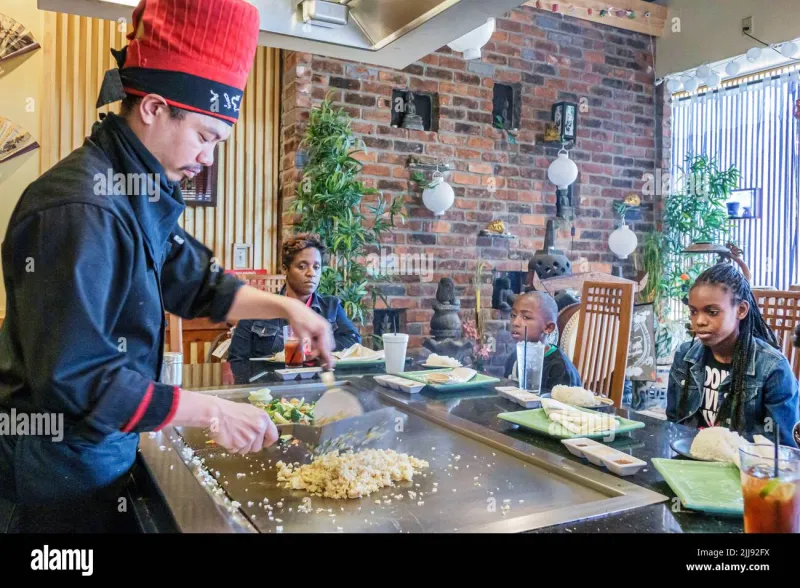
Ask event planners why the format works and they rarely mention the food first. They mention the geometry. At a traditional banquet, the table is a map of social obligation — every placement a statement, every omission an insult. At a teppan counter, there is no head seat and no back corner. Guests stand or sit in a single arc around the griddle, and the chef becomes the center of gravity.
"I stopped doing assigned seating for teppan buyouts entirely," one Los Angeles planner told me. "The counter does the work. Everyone can see everyone. Nobody is stuck at the kids' table because there isn't one."
This is not a small thing. Seating-chart politics have quietly driven more rehearsal-dinner anxiety than any budget dispute. The teppan dissolves the question by dissolving the table.
Entertainment Without a DJ
The second appeal is structural. A rehearsal dinner needs to hold thirty to sixty people's attention for two hours without the couple performing the role of hosts nonstop. Most venues solve this with background music, a slideshow, or an open bar that gradually does the work. The teppan solves it with the meal itself.
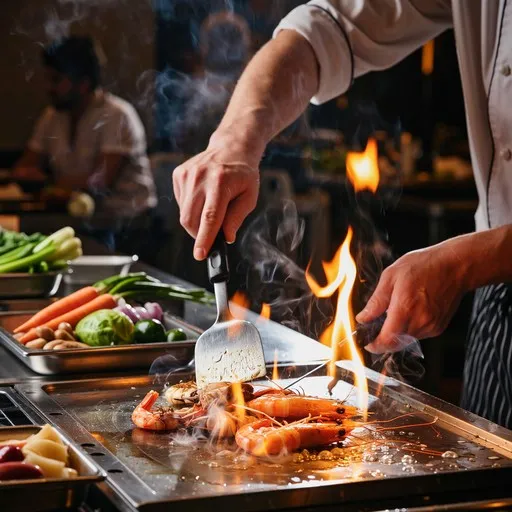
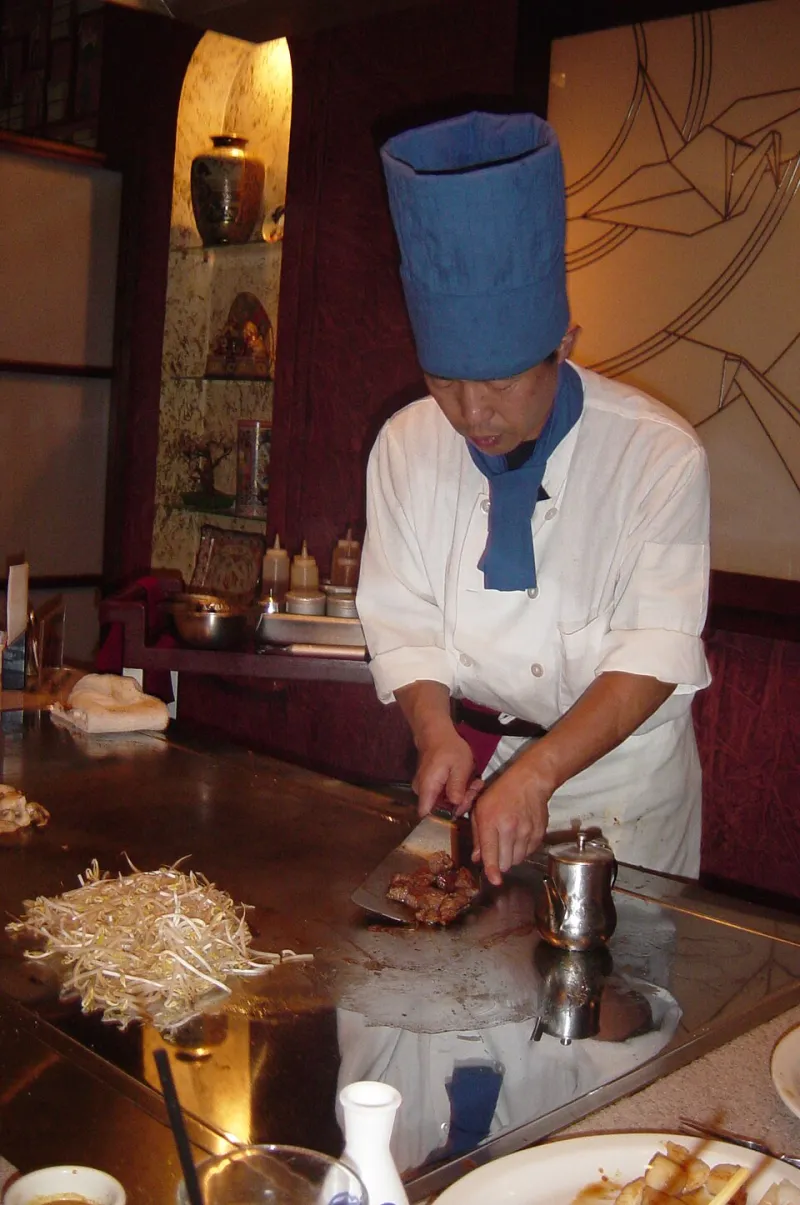
Done well — and the best counters in Chicago, Austin, and New York have refined this into something genuinely elegant — the service is a continuous, quiet performance. Knives in rhythm. A course assembled in front of you. Conversation sparks naturally between neighbors because there is a shared focal point that requires no one to be interesting on demand.
It is worth being clear about what this is not. The balloon-and-fried-rice version of teppanyaki that many Americans grew up with has been steadily giving way, at the higher end, to a more restrained omakase format: fewer flourishes, more precision, courses that unfold in sequence. For a party, this restraint is a feature. The evening has a built-in arc — arrival, first course, the slow accumulation of the menu — that no DJ has to manufacture.
Buyouts, Minimums, and the Fine Print
The logistics are more accessible than most hosts assume. Full-counter buyouts at established teppanyaki restaurants typically run from a food-and-beverage minimum rather than a flat venue fee, often in the range of $2,500 to $8,000 depending on city and party size. Because the kitchen produces every plate in one place, service is synchronized by default — a real advantage over plated banquet dinners, where courses land in staggered waves.
The best hosts ask three questions before signing: how many seats the counter actually holds (some are ten, some are forty), whether the chef will build a fixed omakase around dietary restrictions rather than offering an abbreviated banquet menu, and whether the restaurant's regular dining room will remain open — a detail that shapes the intimacy of the night more than any decor.
Several operators now market buyouts explicitly for weddings, milestone birthdays, and small corporate off-sites, and a few have added semi-private counters that seat twelve to sixteen for parties too large for a chef's table and too small for a ballroom.
An Old Format, Newly Needed
There is a mild irony here. The teppanyaki counter arrived in America in the 1960s as a spectacle, and for decades it carried a reputation as dinner theater — fun, loud, slightly unserious. What today's hosts are discovering is the format's original logic: a meal designed to be watched together is a meal that binds a room together.
For the wedding party the night before the wedding, for the seventy-fifth birthday, for the team that just closed the year — the iron griddle offers something no private room quite can: intimacy without isolation, spectacle without a hired performer, and a seating arrangement that requires no arrangement at all.
The couples booking these counters are not choosing nostalgia. They are choosing the one dining format America built where everyone, by design, gets the front row.