When the Griddle Goes Gratuity-Free: An Argument the Iron Cannot Win
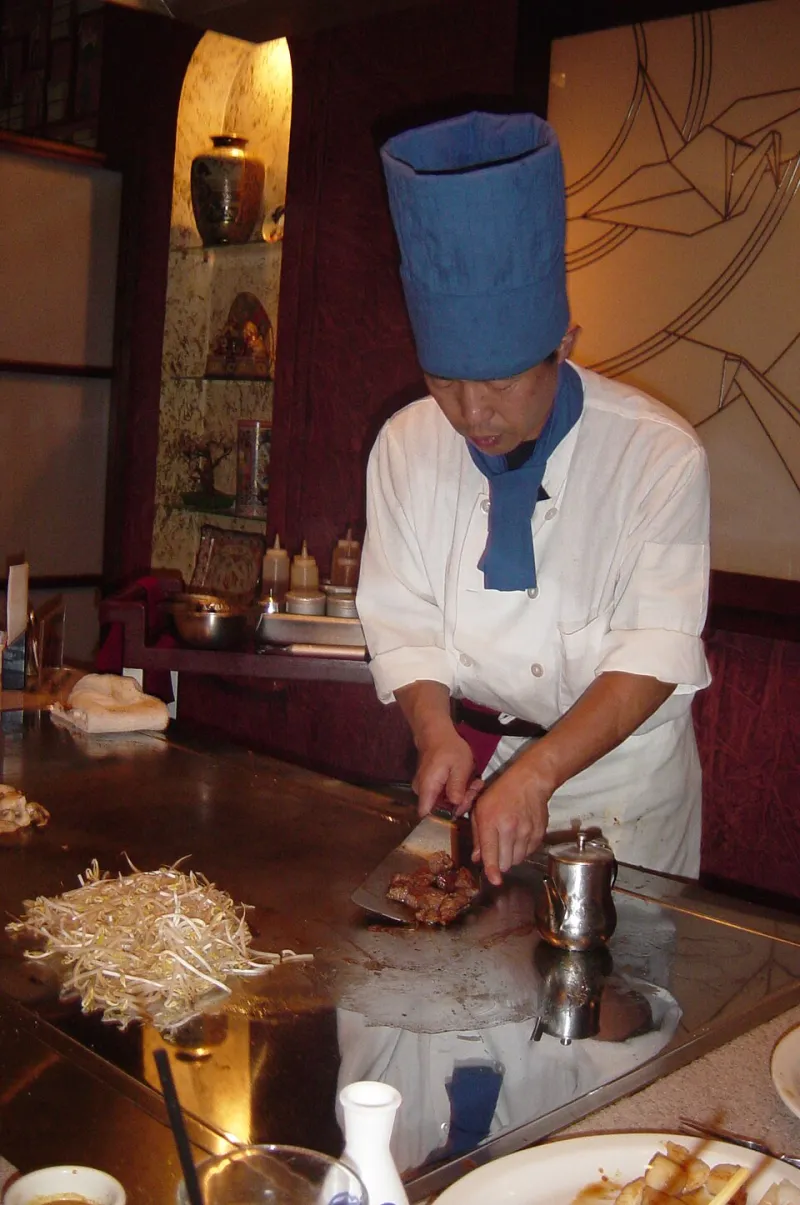
Photo: Dustin M. Ramsey, Attribution, via Wikimedia Commons
Walk into a teppanyaki counter in Los Angeles, Chicago, or New York, and you will notice something diners at most fine restaurants never see: the person cooking your meal is also the person serving it. There is no intermediary, no runner, no captain delivering plates from a kitchen you will never visit. The chef stands three feet away, spatula in hand, for the length of your entire evening.
This structural fact matters now more than ever, because American fine dining is in the middle of a quiet revolution. Across the country, celebrated restaurants have abandoned tipping in favor of higher menu prices, service charges, or hospitality-included pricing. The arguments are serious ones — wage stability, equity between front and back of house, an end to the indignities of a system rooted in post-emancipation labor history. I take those arguments seriously. And yet the teppanyaki counter gives me pause, because it is the one dining format where the tip is not a tax on the guest but a thread in the fabric of the experience itself.
The Gratitude Is Built Into the Room
Most restaurant tipping happens at arm's length, or rather at a restaurant's length — a percentage calculated at the end, handed to a server you spoke with for perhaps twenty cumulative minutes. At the teppan, the exchange is different. You have watched this person work. You have seen the knife touch the steel, the shrimp curl against the iron, the rice pressed and folded with a rhythm you now understand as labor rather than magic.
The gratuity at a teppanyaki counter has traditionally been a form of applause. It closes a performance the way a curtain call does. When restaurants in this format adopt no-tipping models, they do not merely change how the chef is paid — they sever the only direct channel of appreciation the guest has. The ovation, in effect, is canceled.
What the Service-Included Menu Cannot Say
Advocates of hospitality-included pricing argue, correctly, that a chef's compensation should never depend on the mood of a stranger. I agree. But there is a difference between guaranteeing a living wage and eliminating acknowledgment. A no-tipping teppan restaurant can and should pay its chefs well. What it cannot do is replicate the moment when a guest, having spent two hours inches from the fire, looks the cook in the eye and says, simply, thank you — with something behind it.
Some counters have tried to solve this with words: a card at the seat explaining that gratuity is included, an invitation to return rather than to tip. These are courteous gestures. They are also, I would argue, a small impoverishment of the ritual. The tip at the iron was never about the money. It was about completing a circuit that ran from the chef's hands, across the griddle, to your plate, and back.
A Format That Cannot Outsource Its Labor
There is also a practical wrinkle that no-tipping advocates sometimes overlook. In a traditional fine dining room, a service charge can be distributed across a large staff — bussers, runners, sommeliers, expediters. At a teppanyaki counter, the labor is concentrated in one visible person. If hospitality-included pricing fails to translate that concentration into genuinely higher wages for the chef on the griddle, the model doesn't just flatten the tip; it may reduce the earnings of the very performer the format depends on.
American teppan restaurants already face a succession problem — a shortage of young chefs willing to train a decade for the iron. Removing the gratuity without rigorously raising base pay would make the profession harder to justify, not easier. Any restaurant considering the transition should be able to answer, in specific dollar figures, what the chef at the counter earns before and after. If the answer is vague, the model is not ready.
A Modest Proposal
I am not arguing that tipping culture is sacred. It is flawed, inequitable, and historically burdened. But I would ask teppanyaki operators considering a no-tipping model to treat the format's peculiar intimacy as a design constraint, not an inconvenience. Build the appreciation back in. Raise prices transparently, pay the griddle chef a salary that reflects their visibility, and then create a new closing ritual — a handwritten note, a small poured pour, a moment of spoken thanks — that honors what the tip used to carry.
The iron teaches a lesson relevant here: heat applied carelessly ruins what it means to refine. Teppanyaki can join the post-tipping future. But it should do so deliberately, protecting the direct exchange between guest and griddle that no other American dining format can offer. The seat has always come with a price. Let us simply make sure the chef, not the spreadsheet, is the one who benefits.