The Fat Is the Philosophy: Sourcing Lessons from Griddles in Kyoto and the American Heartland
Every teppanyaki chef carries a private taxonomy of fats. Beef tallow rendered from the day's trim. Garlic oil steeped low and slow. A knob of butter, sometimes infused with truffle, held in reserve for the final glaze. To the diner, these are flavorings. To the chef, they are the entire argument of the meal — decisions made weeks before service, in conversations with ranchers, renderers, and purveyors, that determine whether the griddle sings or sputters.
Understanding those decisions reveals how a technique born in Kyoto's disciplined kitchens now thrives in the cattle country of the American Midwest.
The Kyoto Doctrine: Fat as Restraint
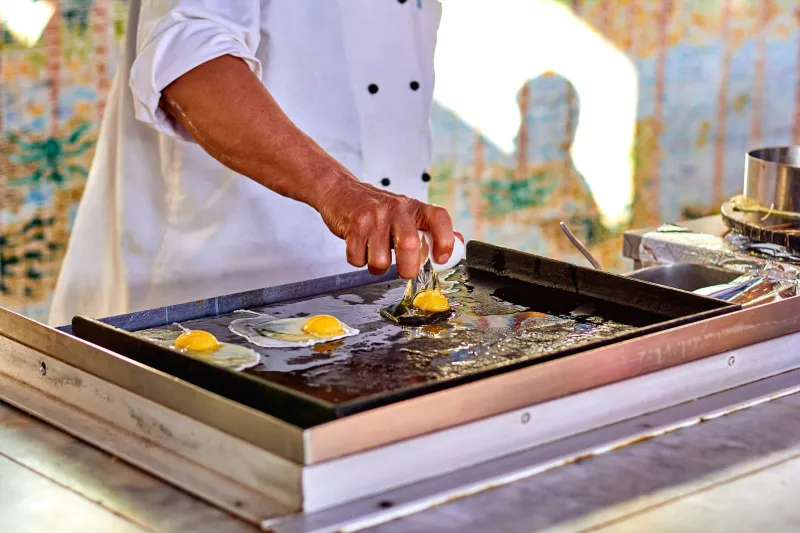
Classical Japanese teppanyaki, as it developed in the hotel kitchens of Kansai, treats fat with near-monastic restraint. The goal is not richness but clarity: the griddle is seasoned over years, the oil applied in thin films, the protein allowed to speak in its own voice. A Kobe beef course might use little beyond a brush of the beef's own rendered fat, circulated across the iron with a spatula and a cloth.
This doctrine rests on an assumption about supply. Wagyu's marbling is so abundant that the fat renders itself; the chef's job is to manage it, not add to it. Flavor comes from precision — the exact moment the sear forms, the temperature at which the meat rests — rather than from accumulation.
American chefs trained in this tradition discover quickly that the doctrine does not transplant whole. American beef, even premium corn-fed prime, carries different fat chemistry: less intramuscular marbling on average, a larger lean muscle, a different melt point. The Kyoto hand must adjust, and the adjustment begins with sourcing.
The American Translation: Tallow, Garlic, and Butter
Walk the kitchens of the best teppan counters in Kansas City, Omaha, or Chicago and you will find a working vocabulary of fats that would startle a traditionalist — and yet every choice obeys the old logic of clarity.
Beef tallow is the backbone. Many chefs render their own from the fat caps of the same steaks they serve, creating a closed loop: the trim of Tuesday's ribeye becomes Wednesday's cooking medium. Tallow's high smoke point suits the griddle's sustained heat, and its flavor — deeper, grassier or cornier depending on the ranch — becomes a signature. A chef sourcing from a single Missouri or Iowa producer can taste the season in the tallow, much as a Kyoto chef tastes the prefecture in the beef.
Garlic oil functions as the bridge between griddle courses. Sliced garlic sweated in neutral oil until just golden, then strained, it seasons the vegetables, the rice, and the steel itself without overpowering delicate fish or lean cuts. It is the most forgiving fat on the line and the most frequently abused; the difference between a perfume and a greasy film is roughly thirty seconds of heat.
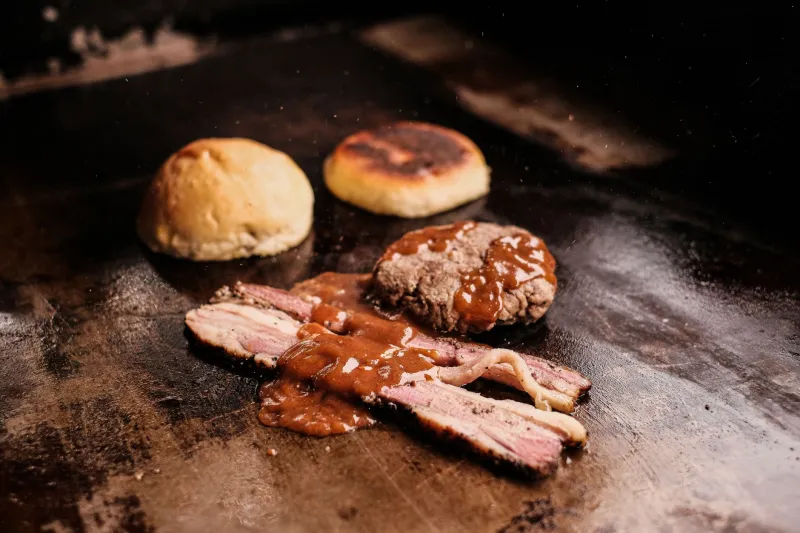
Truffle butter is the American indulgence, and the best chefs treat it as a punctuation mark rather than a sauce. A small compound of cultured butter and a measured amount of truffle arsine finishes the steak course — never the seafood — melting across the sliced meat in the final seconds on the iron. Used this way, it nods to the Midwestern steakhouse without surrendering the Japanese insistence that fat serve the ingredient, not eclipse it.
Proteins Follow the Fat
Sourcing does not stop at the oil. The fat determines which proteins belong on the griddle at all.
Fatty, well-marbled cuts — ribeye, striploin, short rib carved thin — thrive under tallow and minimal intervention. Leaner proteins demand different handling: scallops and Gulf shrimp take to a whisper of garlic oil, while Midwestern pork loin, often dismissed on coastal menus, performs beautifully when finished with rendered fat from its own trim. Chefs working in cattle country report a quiet advantage over their coastal peers: proximity to whole carcasses means fresher fat, better trim, and renderers who will do custom batches. In Kyoto, the discipline is restraint. In Kansas City, the discipline is logistics.
The Griddle as Meeting Point
What emerges from this translation is not fusion but negotiation. Japanese technique supplies the grammar — restraint, sequence, the griddle as a single continuous performance. American sourcing supplies the vocabulary — tallow from regional ranches, garlic oil instead of dashi-kissed stocks, butter where wagyu's own fat would once have sufficed.
The chefs doing this work best are the ones who refuse to treat either side as fixed. They ask the rancher what the cattle ate. They render, taste, adjust. They understand that on a teppan griddle, there is no sauce to hide behind and no closed kitchen to obscure the truth. The fat is on the iron, the iron is in full view, and everything the chef believes about sourcing is exposed in the first sizzle.
That is the philosophy, reduced to its essence: choose your fat the way you would choose your collaborators — carefully, locally, and with the understanding that it will announce itself in every course.