Reading the Iron: Seven Truths Every Teppanyaki Chef Knows and Most Diners Don't
To the casual observer, teppanyaki looks like performance: the spinning spatula, the tower of sliced onion erupting in flame, the egg tossed and caught in midair. The theatrics are real, and they have their place — but they are the curtain, not the play. What actually defines great teppanyaki is a body of technique refined on a slab of heated iron, where a chef's margin for error is measured in seconds and a few degrees of temperature. Here is what the masters wish every guest at the counter understood.
1. The Griddle Is an Instrument, Not a Pan
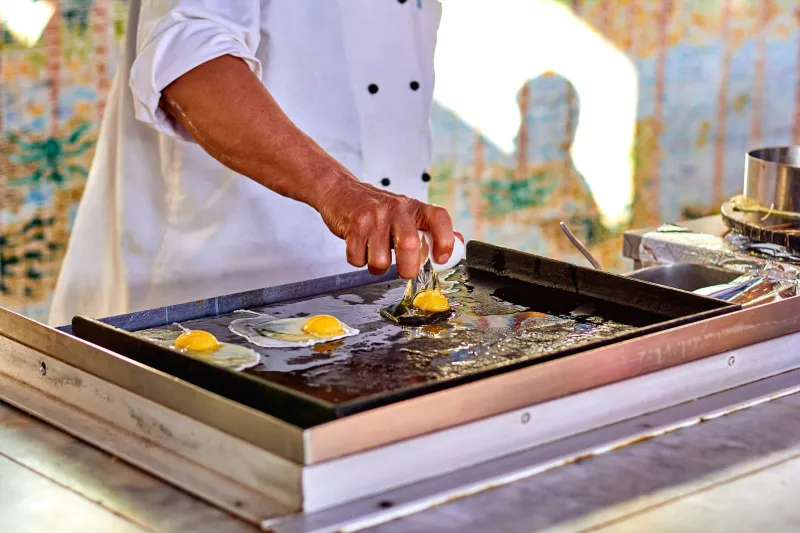
A teppan is not simply a big flat skillet. It is a calibrated surface with distinct thermal zones — hotter near the burners, cooler toward the edges — and skilled chefs cook across those zones like a guitarist moving up and down the neck. A piece of Kobe-style beef might start hot to sear, then rest on the cooler edge while the vegetables take their turn. Watch where the chef places food, not just how they move it. Position is seasoning.
2. Heat Control Is the Entire Job
Anyone can make a griddle hot. The craft lies in modulating it. Teppanyaki chefs work in a constant dialogue with their surface — lifting food to let the iron recover, adding fat to carry heat into thin slices, adjusting burner output mid-course without ever looking down. The difference between a glistening, caramelized crust and a gray, steamed piece of protein is often a ten-degree difference sustained for thirty seconds. The chef's hand hovers over the iron constantly, reading temperature the way a baker reads dough.
3. Sequencing Is Everything
On a teppan, every ingredient leaves a trace. Beef leaves fat and fond; shrimp leaves sweetness; garlic leaves everything. That is why the order of cooking is choreographed as carefully as a tasting menu — because it is one. Delicate items come first, before the surface carries flavors from richer ingredients. Proteins that benefit from rendered fat cook after the items that will benefit from that fat. When a chef wipes the griddle with a cloth and a splash of water between courses, that is not tidiness. It is a reset, protecting the next course from the last one.
4. Garlic Goes On Last — Always
Among the most common misreadings of the teppan: guests assume garlic is a starting flavor, tossed in first like an Italian soffritto. In teppanyaki, garlic is a finish. Minced and added at the end, it toasts briefly in the pan's residual fat, turning crisp and golden without burning. Added early, it would scorch on the high-heat surface and turn bitter, poisoning everything that followed. The garlic chip that crowns your steak is a final gesture, not a foundation.
5. The Oil Is Chosen Like a Wine Pairing
Most diners never think about the oil, but teppanyaki chefs select it the way a sommelier selects a pour. Neutral rice-bran oil has a high smoke point — essential on a surface that can exceed 400 degrees Fahrenheit — and adds nothing that would compete with the ingredient. Sometimes a touch of flavored oil finishes a dish. The point is that oil on a teppan is a heat-transfer medium and a flavor decision at once, and both jobs are considered on every course.
6. Timing Lives in the Sizzle, Not the Clock
Ask a teppanyaki chef how long they cook a scallop and you may get a shrug. The honest answer is that they listen. The teppan speaks — a high, aggressive sizzle means moisture is still escaping and a sear is forming; the sound softening means the surface is drying and the flip is due. Chefs train for years to hear the moment before the moment. Add the visual cues, the resistance under the spatula, the smell at the edge of the food, and you begin to understand that the griddle work is closer to jazz than to a recipe. The performance you see is synchronized to signals most of us never learned to perceive.
7. The Iron Itself Is a Veteran of the Kitchen
Here is perhaps the best-kept secret: a great teppan improves with age. Like a cast-iron skillet or a wok passed down through a restaurant family, the griddle develops a seasoned patina over years of service — layer upon layer of polymerized oil that makes the surface subtly nonstick, that carries the ghost flavors of ten thousand meals, that browns food more evenly than any new slab ever could. Chefs guard it accordingly. Harsh abrasives are banned; cleaning is ritual and restraint. Some of the finest teppans in Japan have been in service for decades, and their cooks will tell you the iron remembers.
Watching With New Eyes
The next time you take a seat at the teppan, watch for the quiet things. Notice the chef testing the surface with a flick of water. Notice where each ingredient is placed and when the spatula rests. Notice the garlic arriving at the end, and the sizzle changing pitch as the evening unfolds. The volcano will still be there, and the knife work will still impress. But the real artistry is in the iron — and now you know how to read it.