The Strip Mall Griddle: Where America's Most Honest Teppanyaki Is Hiding in Plain Sight
There is a persistent belief among American diners that excellence announces itself. It wears a designer lobby. It requires a reservation made thirty days in advance. It sits on the fortieth floor of a downtown tower with a view that costs more than the wagyu. When it comes to teppanyaki, this assumption has done us a disservice.
After a decade of eating at iron griddles across this country — from Bellevue to Buckhead, from Manhattan's midtown temples of beef to a converted taqueria in Sacramento — I have come to a conclusion that the industry would rather I keep quiet: the best omakase-grade teppanyaki in America is increasingly found in unassuming, family-run counters in strip malls and suburban plazas, far from the spotlight of the big-city tasting-menu scene.
The Economics of Quiet Excellence
Consider the arithmetic. A flagship teppanyaki restaurant in a major American city carries rent that can exceed $40,000 a month, a beverage program engineered by consultants, and a marketing budget that must fill two hundred seats a night. Something has to give. Too often, it is the griddle itself — the cooking becomes a production, the ingredients a cost center, the experience a theme.
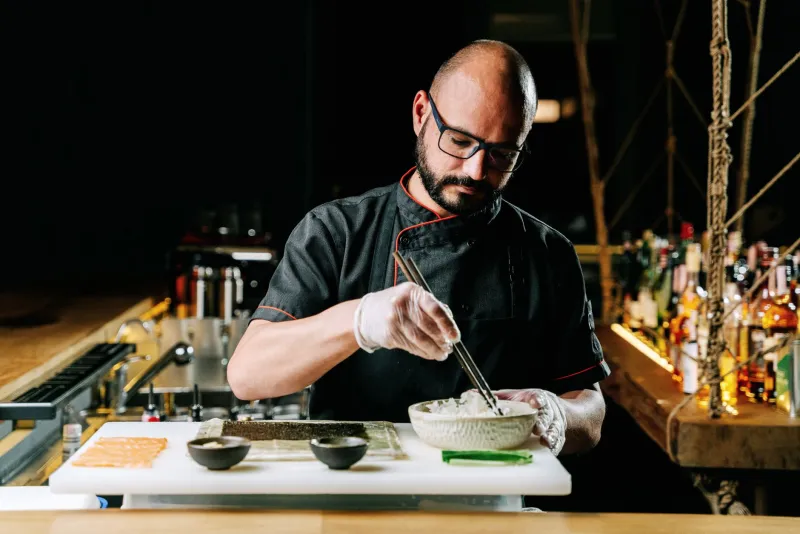
The family-run counter in a suburban plaza operates under entirely different pressures. Rent is a fraction of the downtown figure. There is no landlord of ambition, no investor expecting a return on ambiance. What remains, almost pure and undiluted, is the food. The chef — often the owner, often trained in Osaka or Hiroshima before emigrating — buys the short rib and the Hokkaido scallops personally, cooks them on a griddle he has seasoned for a decade, and serves eight people a night instead of eighty. The fire is smaller. The cooking is, paradoxically, bigger.
Three Counters Worth the Detour
I will not pretend these places are secret much longer, but they deserve naming in spirit if not always in address. Consider the archetypes.
First, the retired master. In a plain storefront outside Atlanta, a chef in his sixties works a single griddle four nights a week, offering no menu at all — you eat what he bought that morning. His garlic rice alone justifies the drive. He does not flip a shrimp into your hat. He does not need to.
Second, the second generation. In a Phoenix strip mall, the daughter of Japanese immigrants runs a counter where her parents' techniques meet Arizona citrus and local wagyu suppliers. Her knife roll is Japanese steel, her griddle scrubbed to a mirror. She is doing something neither fully traditional nor fully American — and it is quietly brilliant.
Third, the widowed counter. In a New Jersey plaza, a widow carries on the teppan restaurant she ran with her late husband, refusing to change a single recipe. Regulars drive from three states. There is no website. There does not need to be.
How to Spot Greatness Before You Sit Down
Not every modest storefront conceals mastery, so here is the framework I use — three signals visible before the first course arrives.
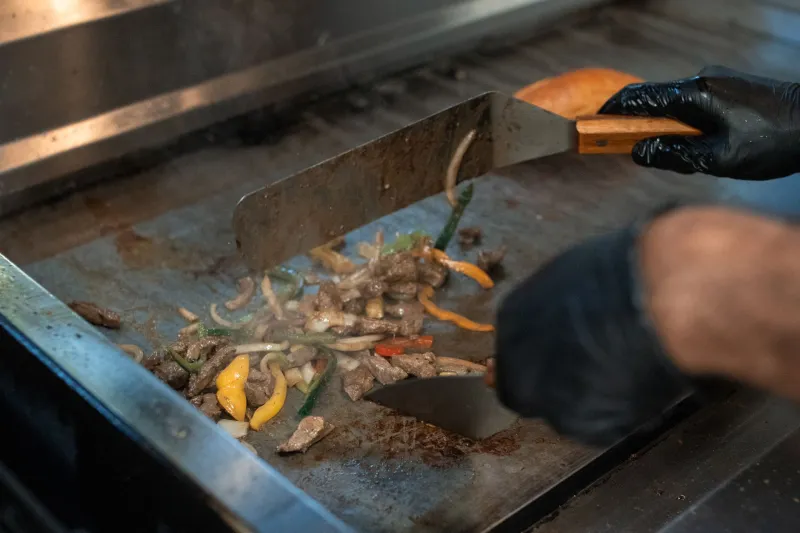
Read the griddle. A serious teppan surface is maintained like a cast-iron heirloom: uniform, dark, lightly oiled, free of carbon buildup at the edges. If the steel looks neglected or scarred, the kitchen behind it likely is too.
Watch the knife roll. A chef who unrolls quality Japanese blades — single-bevel, well-maintained, sharpened personally — is telling you how he regards his craft. A drawer of dull stamped knives tells a different story.
Count the seats, not the reviews. The ideal ratio is a small counter, a short menu, and a chef who shops himself. Eight seats and no sign of a laminated picture menu is a far better omen than a hundred glowing reviews of a hibachi spectacular.
The Case for the Detour
We have spent sixty years teaching Americans that teppanyaki is a show. The quiet counters of suburban America are teaching the opposite lesson: that the iron griddle, in patient and practiced hands, is capable of the same refinement as any sushi counter in Ginza. The distance is not in the food. It is in our willingness to drive past the valet stand and into a parking lot shared with a pharmacy.
Go anyway. The best meal of your year may be waiting between the nail salon and the dry cleaner, on a griddle polished by twenty years of devotion.