No Blades at the Counter: The Quiet Absence That Defines Teppanyaki
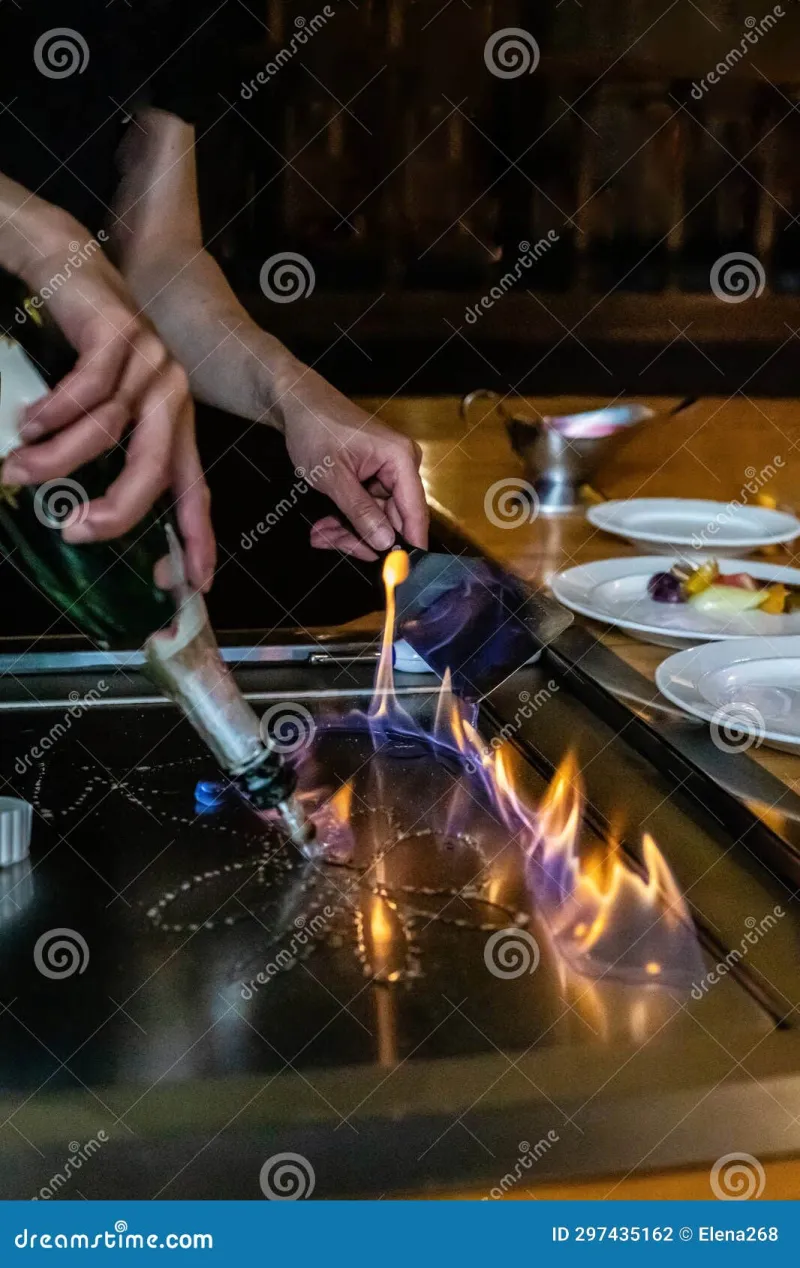
Photo: teppanyaki chef spatula griddle close up fine dining, via thumbs.dreamstime.com
Walk up to nearly any dining counter in America and you will find the same silent arsenal: a steak knife resting beside the bread plate, a fork waiting at attention, perhaps a serrated blade for anything crusty. Walk up to a teppanyaki counter — a genuine one, in the Kyoto lineage rather than the hibachi-theater tradition — and you will find none of it. No knife beside your plate. No fork. What arrives instead is a pair of chopsticks, a small dish of sauce, and the understanding that everything set before you is already done.
This absence is not an oversight. It is the cuisine.
The Knife Did Its Work Earlier
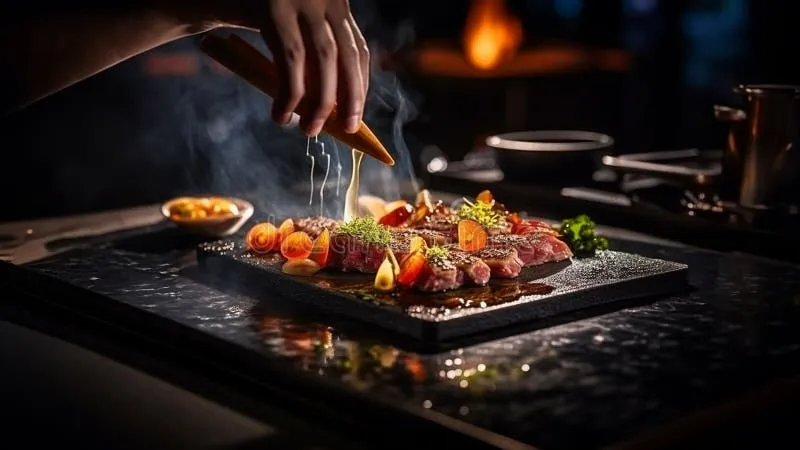
The first thing to understand is that the knife has not been banished from teppanyaki. It has simply been retired to the prep room, where it belongs. A proper teppan chef spends the first hour of service with a yanagiba or deba, cutting protein and vegetables into uniform pieces whose dimensions are not aesthetic whims but engineering decisions. A cube of Wagyu cut to a precise weight sears to a precise doneness in a precise number of seconds on iron held at a known temperature.
By the time anything reaches the griddle, the geometry is settled. The knife's judgment has already been rendered. What remains for the teppan is conversion — raw to cooked, firm to yielding — and conversion is the spatula's domain.
The Quiet Hierarchy of Spatulas
Visitors to a serious teppan kitchen are often surprised to learn there is no single spatula. There are many, each with a role in an unspoken hierarchy.
The heavy steel turner, broad and rigid, handles the proteins — it can slide under a ribeye without compressing it, lift a lobster tail without tearing it. The slim héra, the Japanese teppan spatula with its flexible edge, does the delicate work: separating an egg yolk at the last moment, dividing fried rice into clean portions, scraping the griddle clean between courses without scratching the seasoned surface. And in some kitchens, a pair of long chopstick-like paddles performs work no Western tool can — turning a single slice of zucchini with the precision of a surgeon and none of the puncture of a fork.
That last point matters more than it seems. A fork pierces. A knife saws. Both wound the food they touch. The teppan toolkit is built entirely around tools that persuade rather than puncture, which is why the cuisine is so obsessed with texture.
Texture as the Whole Argument
Strip away the theater — the onion volcano, the flying shrimp — and what remains at the heart of teppanyaki is a texture-first argument. The seared crust against the yielding interior. The snap of a bean sprout against the give of a scallop. The rice, each grain distinct, never gummy, never broken.
A knife at the table would undo this argument mid-sentence. Saw a piece of seared Wagyu in half with a steak knife and you drag the crust off the interior, you smear the marbled fat, you collapse the very contrast the chef spent the evening building. Teppanyaki portions are cut — by the chef, on the iron, at the moment of perfect doneness — to be eaten in one or two bites, without further intervention. The bite size is a promise: nothing here needs your help.
American steakhouses, by contrast, hand you a knife as a matter of course, and the steak arrives in slabs meant to be divided. Neither approach is wrong. But the teppan approach relocates responsibility. The kitchen finishes the work; the diner simply receives it.
Served From the Source
There is a second intimacy hiding in this knife-free arrangement: the food often never touches a plate at all until the moment of service. At many counters, the chef portions directly onto your dish, sometimes from the spatula itself, the iron still hissing a foot away. The gap between cooking surface and diner collapses to inches.
This is only possible because nothing sharp is in play. A chef working inches from guests cannot use long forks to maneuver food; the risk is obvious. Spatulas and chopstick-paddles keep every motion horizontal, controlled, and safe. The tooling and the intimacy are inseparable — the same implements that protect the texture also make it possible to serve you from arm's length, with the cook watching your face as you take the first bite.
That feedback loop is the quiet luxury of the format. A chef who hands a steak off to a passing server never learns whether the sear landed. A teppan chef sees your eyes widen, or your nod, and adjusts the next course accordingly.
What the Absence Teaches
Sit down at a counter and notice what is missing. In teppanyaki, the missing knife is the point. It tells you that the chef trusts the cut, the timing, and the iron — and it asks you to trust them back. In an American dining culture that prizes customization, substitution, and the diner's hand in everything, there is something almost radical about a meal that arrives finished, textured, and complete, requiring nothing from you but your attention.
The knife is silent because its work is done. What speaks instead is the iron, and it speaks clearly.