Twelve Minutes of Iron: A Minute-by-Minute Companion to Your First Teppanyaki Omakase
Photo: Shazaalmadina, CC BY-SA 3.0, via Wikimedia Commons
The first visit to a teppanyaki counter carries a particular anxiety. Unlike a sushi omakase, where the ritual is hushed and the choreography subtle, teppanyaki happens in full view — fire, steel, and the chef's hands all exposed, three feet from your face. You are not merely dining; you are watching someone work, and you are being watched in return.
What most first-timers don't realize is that a well-run teppan omakase is built on a compressed timeline. From the moment the chef begins preparing the griddle to the closing rice course, the arc of a focused counter experience can unfold in roughly twelve minutes of active cooking. Those minutes have a grammar. Learn it, and the meal stops feeling like a performance you might interrupt and starts feeling like a conversation you've been invited into.
Minute One: The Wipe
The chef begins before you've finished settling onto your stool. The griddle is scraped, then wiped with a cloth and a shallow pool of oil, then wiped again. This is not cleaning; it is seasoning and temperature-reading in real time. A flick of water skitters across the steel — the chef is listening for the hiss that says the surface is ready.
What to do: Sit down fully. Unfold your napkin. Put your phone away. The meal has begun even though no food has appeared.
Minutes Two and Three: Fat, Aromatics, and the First Gesture
A thin veil of oil or rendered fat goes down, followed — in many American counters influenced by Kyoto tradition — by nothing at all. The restraint is the point. Then the aromatics: onion, perhaps garlic, sometimes just the fat itself, left to speak.
This is when the first slice of protein or vegetable hits the iron and the aroma reaches you before the plate does. Consider that scent your first course. It is also your first cue: the chef is calibrating to the room. If guests lean in, the pace holds. If someone recoils, the smoke is managed differently.
What to say: Little. A nod when the chef introduces an ingredient is enough. Save questions for natural pauses — when the chef's hands are still, not mid-toss.
Minutes Four and Five: The Vegetable Interlude
Vegetables arrive first in most omakase sequences — zucchini, mushroom, onion, seasonal produce chosen that morning. They cook fast and they cook loudly, and this is where many chefs establish rhythm with the room. Watch how the chef portions: pieces destined for your plate are cut and set in a deliberate geography on the griddle.
Etiquette signal: Eat what's served when it's served. Vegetables left cooling on your plate while you wait for the steak tell the chef you're eating on your own schedule, not the kitchen's.
Minutes Six and Seven: The Protein, and the Question of Doneness
Here the chef may ask how you'd like your protein prepared — or, at a stricter omakase counter, may not ask at all, because the cut, the marbling, and the griddle temperature have already decided. Both approaches are legitimate. If asked, answer plainly. If not asked, trust it.
When to photograph: This is the moment, if you must. The sear, the fold, the single slice cut to show the interior — it is the most photogenic thirty seconds of the meal. Take one frame, quickly, and lower the phone. Photographing every course turns the counter into a studio, and the chef will quietly adjust.
Minutes Eight and Nine: The Saucing and the Handoff
Sauce at a serious teppan counter is applied on the iron, not at the table. A brushstroke of tare, a smear of citrus, a flake of salt. The chef slides the finished piece onto your plate with a spatula-and-fork motion that took years to make invisible.
What to do: Eat it within moments. Teppanyaki has a clock on it that no other cuisine quite matches — the sear is at its peak for roughly ninety seconds. This is the single most important courtesy at the counter.
Minutes Ten and Eleven: Garlic Rice and the Economy of the Griddle
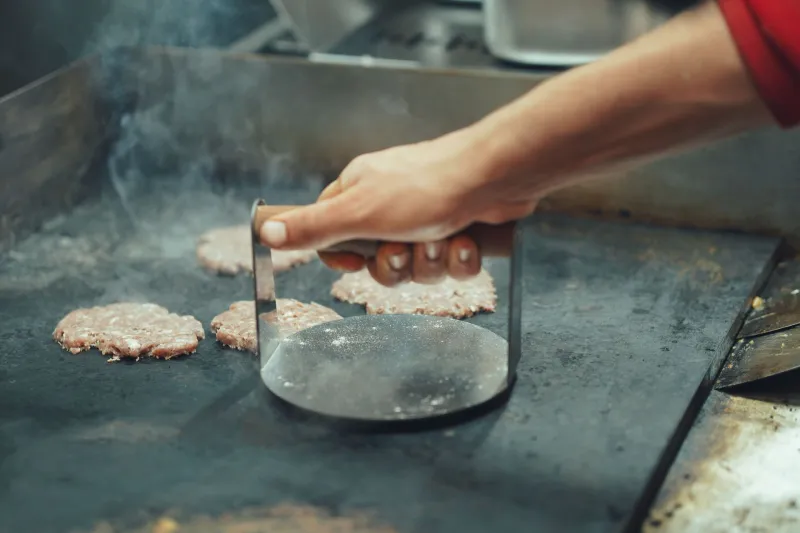
The final savory course is, in the American teppan tradition, the garlic rice — made on the same surface, absorbing everything the meal left behind. Some chefs press the rice into a flat cake to develop a crust; some fold in egg with a flick that looks casual and isn't. This is the griddle's second language: the meal cooking itself out of its own residue.
Etiquette signal: Finish the rice, or most of it. At many counters, an emptied rice bowl is the unspoken signal that you're satisfied, and it cues the close.
Minute Twelve: The Final Wipe
The chef cleans the iron the way they started — scrape, oil, cloth. In serious kitchens, this closing wipe mirrors the opening one, a full circle that tells you the griddle is a living tool, not a stove.
Then, simply: thank you. Say it to the chef directly, not to the room. Gochisousama deshita is welcome at most counters; a sincere "that was wonderful" in plain English is welcome everywhere.
The Quiet Vocabulary of a Good Guest
A few signals do disproportionate work at the counter:
- Eyes up. The chef can tell who's watching, and it shapes the showmanship — or its restraint.
- One question, well placed. A single informed question ("Is that wagyu from Kagoshima?") earns more warmth than a dozen.
- Empty plate, upright posture, unhurried hands. These read as respect across every teppan kitchen from Osaka to Ohio.
Twelve minutes is not much time. But handled well — by the chef and by you — it contains an entire arc: preparation, arrival, peak, and close. The nervousness fades the moment you realize the meal was never a test. It was an invitation, and the iron was simply the place you both agreed to meet.