The Low-Flame Ledger: Can Teppanyaki Balance Carbon and Ceremony?
Photo: energy efficient teppanyaki restaurant griddle ventilation sustainable kitchen, via c8.alamy.com
The Open Flame Problem
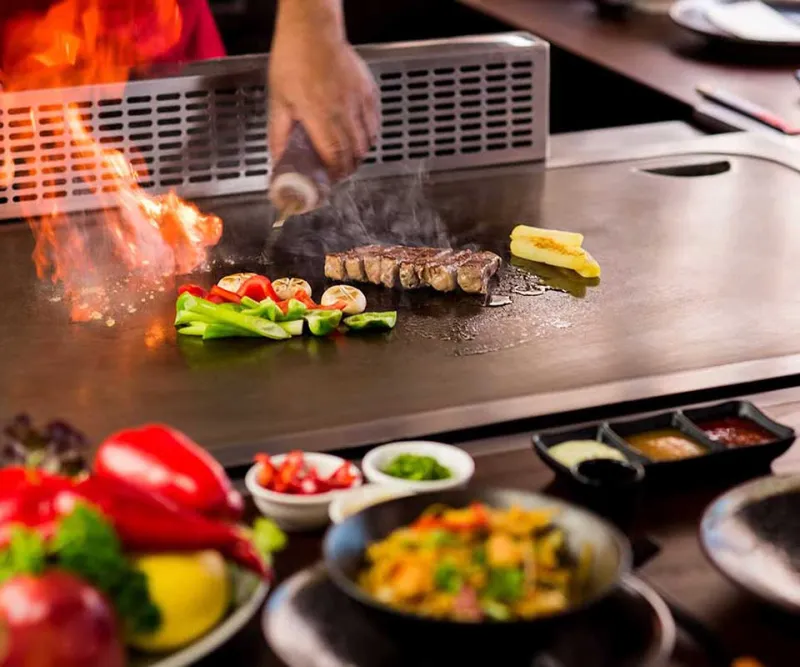
Teppanyaki is a cuisine built around visible energy. The griddle is hot, the ventilation is powerful, and the chef's performance depends on a certain theatricality of heat. That is the pleasure of the format. It is also the reason the format attracts environmental scrutiny. In 2026, as American restaurants face rising energy costs and growing pressure to report emissions, the teppan counter is an uncomfortable symbol: a dining room where the most memorable element is also the most energy-intensive.
The question is not whether teppanyaki can become a low-impact cuisine. It cannot. Any restaurant that heats a large steel surface to searing temperatures and runs a ventilation system capable of clearing smoke and steam will consume significant energy. The real question is whether the format can reduce its footprint without reducing its soul. That requires looking at the whole ledger—energy, ventilation, sourcing, waste, and the less visible costs of spectacle.
Energy, Ventilation, and the Hidden Load
The teppan griddle is only part of the energy story. The ventilation system is often the larger load. A high-end teppan counter must clear smoke, grease, and heat from the dining room while maintaining comfortable air for guests seated inches from the cooking surface. That requires powerful fans, makeup air systems, and sometimes additional cooling. The result is a restaurant that uses more energy per square foot than many other fine-dining formats.
Operators can address this in several ways. Induction-assisted griddles can reduce the energy required to maintain temperature, though they change the cooking surface's responsiveness. Heat-recovery ventilation can capture some of the waste heat and use it to preheat water or air. Scheduled ventilation—running the system at full power only when the griddle is active—can reduce waste without compromising the guest experience. None of these solutions is glamorous. All of them matter. The low-flame ledger is not a single invention. It is a series of small operational decisions.
Sourcing as the First Lever
For many teppan counters, the most significant environmental lever is not the griddle. It is the supply chain. Beef, shellfish, and seasonal vegetables all carry embedded carbon, water, and land costs. A restaurant that sources thoughtfully can reduce its footprint more than a restaurant that simply turns down the flame. This is not an argument for removing beef from the menu. It is an argument for knowing where the beef comes from, how it was raised, and whether the portion size is calibrated to the experience rather than to an abstract idea of abundance.
Seasonality is an underused tool. A teppan omakase that follows the season can reduce the distance ingredients travel and the energy required to produce them out of season. It can also improve the meal. The best teppan chefs already cook this way, not because it is sustainable but because it is good. The environmental argument and the culinary argument point in the same direction.
Waste at the Counter
The counter format creates a particular kind of waste. Ingredients are prepped in visible quantities. Trim, shells, and unused portions accumulate quickly. A restaurant that tracks those streams can find savings. Shellfish shells can be composted. Trim can become stock or staff meal. Oil can be filtered and reused within safe limits. The teppan counter's visibility is an advantage here: the chef sees what is being wasted in real time.
The bigger waste is often in the dining room. Teppanyaki portions can be generous to the point of excess, especially in the American market. A menu that offers a smaller omakase sequence, with the option to add courses, can reduce plate waste while giving guests more control. This is not a retreat from hospitality. It is a refinement of it. The best teppan counters have always understood that abundance is a matter of pacing, not volume.
The Spectacle Tax
The hardest question is the one that touches the format's identity. Teppanyaki is not only a cooking method. It is a performance. The onion volcano, the flying shrimp, the knife work—these are part of the American teppan tradition, and they carry an environmental cost in the form of energy, food waste, and the resources required to stage a show. A carbon-light teppan counter must decide which parts of that spectacle are essential and which are merely habitual.
Some operators are already making that decision. They are replacing pyrotechnics with quieter forms of drama: the sear of a scallop, the crackle of rice, the precise placement of a course. This is not a rejection of teppanyaki's history. It is a return to an older idea of the format, one in which the chef's skill is the spectacle. The low-flame ledger does not require the counter to become boring. It requires the counter to become more confident in what it already does well.
A Carbon-Light Counter That Still Feels Like Teppanyaki
The teppan counter will never be a zero-impact restaurant. The iron is hot, the room is ventilated, and the guest has come to watch. But the format can be more honest about its costs and more deliberate about reducing them. That means measuring energy use, sourcing with intention, tracking waste, and questioning the parts of the performance that no longer earn their place.
The result would not be a lesser teppanyaki. It would be a more mature one. The heat would still be there. The immediacy would still be there. The chef would still stand at the center of the counter, reading the room and cooking in front of it. What would change is the ledger behind the flame—a quieter accounting for a cuisine that has always been loud. In 2026, that is not a compromise. It is the next step in the format's evolution.