Before the Food Network, There Was the Counter: How Teppanyaki Taught America to Watch the Cook
There is a moment familiar to anyone who has sat at a teppan counter in this country: the diner leans forward, watches the chef's knife flash across the steel, and then — almost without realizing it — asks a question about the blade. What kind of steel is that? How often is it sharpened? Where does one even buy a knife like that?
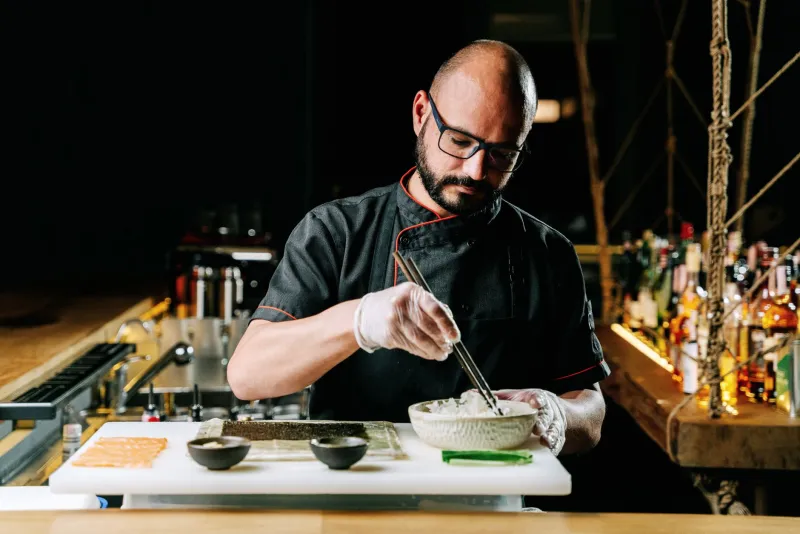
We tend to credit television for this curiosity. We assume Americans learned to care about kitchen equipment from celebrity chefs, competition shows, and the slow-motion beauty shot of a perfectly honed edge. But I would argue the debt runs the other direction. Decades before the open kitchen became a design trend and the chef's knife a household object, the teppanyaki counter was already doing the work: putting the tools on display, night after night, three feet from the customer's face.
The First Open Kitchen Was a Griddle
When teppanyaki arrived in the United States in the 1960s and 1970s, the American restaurant kitchen was a sealed room — a place of mystery, and often deliberately so. Diners saw the menu; they did not see the hands. The teppan counter inverted that arrangement entirely. Here, the kitchen was the dining room. There was no door to close, no line to hide behind. The spatula, the knife, the two steel prongs, the cloth used to wipe the griddle between courses — all of it was theater by necessity, and education by accident.
What diners absorbed at those counters was not merely spectacle. They learned that tools have identities. That the flat edge of a spatula is used differently from its corner. That a knife's job at the griddle is less about chopping than about precise, rhythmic division — the same carrot, cut the same way, twenty times, because consistency is the point. These are not trivial lessons. They are the foundation of what we now casually call "food literacy."
Why the Counter Worked When Nothing Else Did
Skeptics will say the teppan show was just that — a show, a gimmick of flying shrimp and stacked onion rings. Fair enough. But strip away the flame and the trickery, and what remains is something no cooking segment on television can replicate: duration and proximity. A television edit compresses. A counter unfolds. The diner watches the entire arc of a dish, from raw ingredient to finished plate, in real time, with nothing cut out.
That sustained observation is what made the tools legible. You cannot understand a knife from a highlight reel. You can understand it after twenty minutes of watching a chef use it, wipe it, reset it, and use it again — noticing, perhaps, that the blade never touches the steel of the griddle itself, that the edge is protected even mid-performance. That detail, absorbed without commentary, teaches more about knife care than a shelf of instructional books.
From Curiosity to Consumption
The evidence of this education is everywhere in the American marketplace now. Japanese knife retailers report a customer base that grew up watching counter cooking; many can name steels and forge methods their grandparents never heard of. Home cooks buy carbon steel spatulas modeled on the ones they saw across the counter. The teppan griddle itself — once exotic restaurant equipment — now appears in suburban kitchens, usually purchased by someone who first understood its appeal from the customer side.
This is the quiet legacy I want to insist upon: the teppanyaki counter democratized curiosity about equipment. It made it normal, even expected, for a diner to ask about the tools. Today's open kitchens, chef's counters, and YouTube knife reviews all inherited an audience that the griddle created — an audience that learned, at a formative dinner or two, that watching the cook is part of the meal.
What We Owe the Iron
There is a temptation, in food writing, to treat teppanyaki's American history as a footnote — a chapter of novelty restaurants that matured into something serious. I think that gets the causality backwards. The seriousness was always there, in the discipline of the knife work and the honesty of the exposed station. The novelty was simply the doorway through which American diners walked.
So the next time you find yourself admiring a friend's knife roll, or lingering at the counter of an open kitchen, or asking a server what steel the chef prefers — consider where that instinct was trained. For many of us, it was trained at the iron, in a strip-mall dining room or a downtown omakase counter, by a chef who never explained a thing and never needed to. The tools taught us themselves. We only had to be seated close enough to watch.