Two Thousand Miles from the Steel: What a Teppanyaki Chef Carries When the Griddle Can't Come
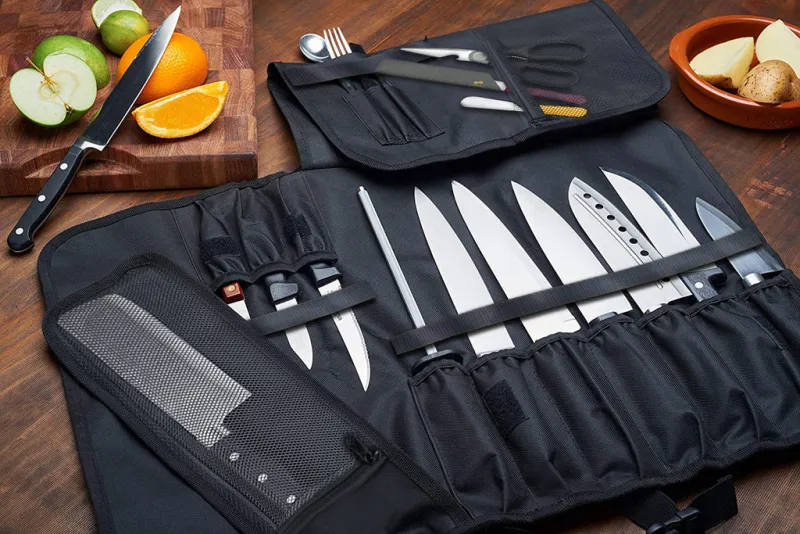
Photo: chef knife roll travel bag kitchen tools packed, via cdn.shopify.com
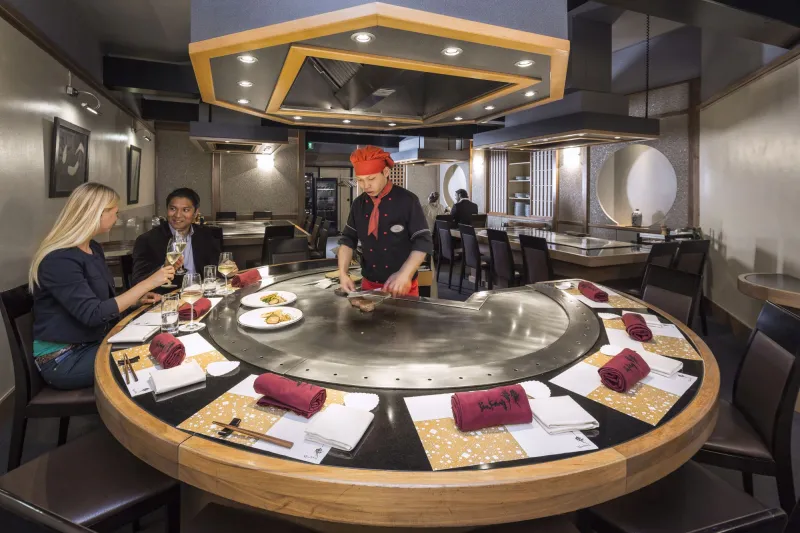
There is a particular silence a teppanyaki chef hears on the first morning of a vacation. It is not the absence of the sizzle — a home kitchen can approximate that with enough butter and conviction. It is the absence of the steel itself: the low, even hum of a griddle holding its temperature across four feet of polished iron, a surface so consistent that the chef's entire spatial memory is mapped to it.
Hiroshi Tanabe, who has worked the counter for nineteen years — the last eleven at a respected omakase-style teppan restaurant in the Chicago suburbs — took two weeks off this past summer to drive from Illinois to the Oregon coast. He agreed to let us ask an odd question: what does a teppanyaki chef pack when the one tool that defines his craft cannot come along?
The Tin That Always Travels
The first item out of his duffel was unremarkable to look at: a small rectangular tin, dented at one corner, holding a blend of sea salt and dried yuzu peel he makes himself. He packs it on every trip longer than three days.
"People think our work is about the fire, the show, the spatula work," he told me over coffee in a motel in Bozeman. "But the griddle does not season anything. My hands do. The salt is the one thing I can carry that is actually mine."
He is not alone in this. Ask around at counter restaurants and you will hear similar confessions — a chef's knife wrapped in a hotel towel, a small bottle of toasted sesame oil, a travel tin of sansho pepper. The equipment-driven reputation of teppanyaki has always obscured a simpler truth: the portable core of the craft is small, and it fits in a bag.
Knife Skills in a Hotel Kitchen
Tanabe's second habit reveals more. Wherever he stays for more than two nights, he finds a grocery store. In Portland it was a market on Hawthorne Boulevard; on the coast, a small co-op. He buys whatever is local — in one memorable stop, Walla Walla sweet onions — and then asks the front desk for a room with a kitchenette, or borrows one from a friend.
What follows is not teppanyaki, and he is the first to say so. It is, instead, an exercise in translation. The precise knife work he performs nightly on the teppan — the even brunoise, the butterflied shrimp, the paper-thin garlic — gets repurposed onto a cutting board, over a burner he does not trust, in a pan that heats unevenly.
"On the steel, I know exactly where the hot spot is. It is like knowing a room," he said. "A hotel burner is a stranger's room. Everything takes longer. The garlic browns before it should."
He described the sensation the way a pianist might describe playing an out-of-tune upright: frustrating, humbling, and strangely instructive. The uneven heat forces him to move food constantly, to rely on instinct rather than the griddle's consistency. "It reminds me that the technique is in my wrists, not the machine. On a bad burner, you find out what you actually know."
What the Iron Cannot Teach
This is where the road trip becomes an argument. Teppanyaki in America is often framed — fairly, sometimes unfairly — as performance cuisine, a dinner theater of flying spatulas and onion volcanoes. The implication is that the chef is interchangeable, that the griddle is the star.
Tanabe's suitcase argues otherwise. Strip away the two-ton steel, the ventilation hood, the counter built to exact height, and what remains is a set of judgments: when the oil is ready by smell alone, how a piece of fish bends at doneness, how much salt a dish wants after the pan has already taken its share. These travel. They fit in a tin and a knife roll.
He cooked the Walla Walla onions in a friend's kitchen near Salem, low and slow, no show, no audience. It took forty minutes on a coil burner that ran hot on one side. He turned them constantly, the way he would on the teppan, and when they were done he salted them from the dented tin and ate them standing up.
"That was the best thing I ate on the whole trip," he said. "Not because it was good. Because it was mine."
Coming Home to the Steel
The most telling moment of our conversations came on his last night on the road, when I asked whether he was eager to get back to the griddle. He thought about it longer than I expected.
"Yes. But not the way you think," he said. "After two weeks of fighting bad burners, the steel feels like forgiveness. The griddle gives back exactly what you put in. That is why guests trust the counter. There is nothing hidden between my hand and the heat."
It is a view of teppanyaki worth holding onto. The theater is real, and for many diners it is the draw. But the road trip suggests the deeper claim: that what looks like an equipment-driven spectacle is, at its center, a craft small enough to carry across the country in a duffel bag — and stubborn enough to surface in a stranger's kitchen, over a coil burner, on a plate of onions eaten standing up.
The knife bag, it turns out, is not what defines the chef. It is merely what he leaves at home.