Booking for One: The Quiet Case for the Solo Teppan Seat
Photo: solo diner seated at Japanese teppanyaki counter watching chef cook, warm restaurant lighting, via hospitalsupplies.co.za
There is a moment, usually at the reservation screen, when a solo diner talks themselves out of teppanyaki. The table seats eight. The griddle is four feet of flat steel. The room is built around a shared course, a shared hood, a shared hour. A party of one looks like a clerical error.
That assumption is worth challenging. In American cities the teppan counter has quietly become one of the most accommodating seats in fine dining for a guest who arrives alone — not because the restaurant pities the single diner, but because the form itself is already structured to host one. The reasons are architectural rather than sentimental, and they are worth setting down plainly.
The Counter Arrives With a Host Attached
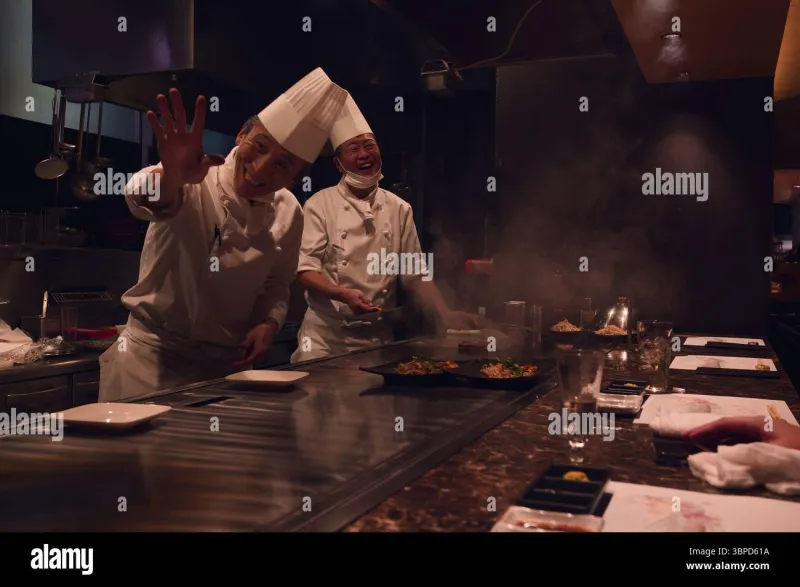
At a bistro, a table for one quietly asks the diner to supply their own occasion. The food arrives; the evening does not. At the teppan, the chef is contracted to provide it. He works a few feet away, narrates the sequence, divides the courses, and paces the room without ever demanding a reply. That arrangement is a gift to the diner who does not wish to perform conversation with a server or maintain a pleasant expression for ninety minutes of silence.
The chef, in other words, is the host you did not have to book separately.
Why the Theatre Relieves Rather Than Exposes
This is the counterintuitive part. Spectacle sounds like the last thing a solo diner wants, and it is in fact the first. The onion volcano, the flame, the knife work — none of it is aimed at you. It is aimed at the iron. You are an audience member rather than a performer, and the lights are on the griddle instead of on your empty second chair.
Diners who eat alone regularly describe the same relief: at a conventional restaurant, solitude reads as a statement; at a teppan counter, it reads as a seat.
Booking: Two Questions Worth Asking
Online systems are unreliable for single diners. Many will not accept a party of one at a teppan table, and some will seat singles at the bar instead — a fine outcome at a sushi counter, a poor one at a griddle, where the whole point is proximity to the iron.
Call the restaurant. Ask two questions directly: does the counter take single reservations, and is the full omakase available to a party of one? A room that offers the tasting menu only to two or more is telling you something useful.
Then ask the logistical ones. Will you be seated with a party already mid-course, or at a fresh table? Is the earliest seating possible? A 5:30 or 5:45 seating on a Tuesday or Wednesday is the most forgiving slot in the week: the room is calm, the chef has time, and the other guests are usually couples rather than a corporate group of twelve.
Ordering: Take the Whole Thing
There is a temptation to downshift — a small plate, a single course, an apologetic order. Resist it. Teppanyaki is a sequence, and half the pleasure of the sequence is its timing: the cold first course, the vegetables, the seafood, the beef, the rice, the quiet finish. Ordering fragments of an omakase is like reading every third chapter of a short novel.
Wine and sake deserve the same confidence. A glass list is perfectly respectable for one. So, for that matter, is a bottle; most serious counters will stopper and hold what you do not finish, and a solo guest who orders well is not a burden but a compliment.
The Etiquette Nobody Prints
A short list, assembled from chefs and from regulars who dine alone often.
- Phones face down. A photograph of the griddle takes fifteen seconds; a meal conducted through a screen takes ninety minutes and dims the room for everyone at the table.
- You are not obliged to talk to your neighbors, and you are not obliged to ignore them. The middle path — a nod at the first course, silence during the cooking — reads as courteous in every American teppan room.
- Ask the chef questions if you want them, and stop if the answer is short. A working griddle is hot, and a chef mid-course cannot always be a conversationalist.
- Signal the finish by placing your chopsticks down parallel on the rest, not across the bowl.
- Tip on the whole bill, and if the chef has cooked for you alone, remember that the gratuity is a professional courtesy, not an afterthought.
- Leave when the course ends. A solo diner who lingers over a cold griddle is holding a table the room needs.
What a Single Seat Costs
Prices vary widely by city and by the ambition of the kitchen. In mid-market American cities a full teppan omakase commonly runs between eighty-five and one hundred fifty dollars per person; in major metropolitan rooms, two hundred and above is no longer unusual. Some counters carry a per-seat minimum at prime hours.
Against that, consider the arithmetic of eating alone: a single seat is frequently the least expensive way to eat the best fish of the night, because you are not splitting a large format course and you are not ordering the (invariably larger) party menu.
The Night It Works
A Tuesday, a few minutes before six. Four strangers at the iron — two couples, one guest alone. The chef said very little and cooked with care, and somewhere around the third course he set the first piece of seared scallop in front of the solo diner without comment and without ceremony. Nobody applauded. Nobody needed to. The evening had already done what an evening is supposed to do.
Solitude, With Company
This is the argument in one sentence: the teppan counter does not replace company, it supplies just enough of it — a host, a rhythm, a modest shared attention — that solitude stops being a problem to solve and becomes an atmosphere to sit inside.
Book the early seating. Order the whole thing. Watch the iron.